
What are Balance and Falls Prevention Programs?
Balance and Falls Prevention Programs improve a person’s ability to remain stable, move safely, complete daily activities and recover from an unexpected loss of balance.
Effective balance depends on adequate strength, joint movement, sensation, vision, vestibular function, coordination, reaction speed, attention, confidence and the ability to adapt movement to changing environments. A limitation in any of these areas can affect sitting, standing, reaching, walking, turning, stepping and recovery from a trip or slip.
Falls prevention involves more than practising difficult standing positions. A complete program assesses and treats sitting balance, standing balance, dynamic movement, functional reaching, walking adaptability, postural reactions, lower limb and trunk strength, stepping responses, footwear, mobility equipment, dizziness, vision, medications, environmental hazards and fear of falling.
The goal is to improve safe mobility and maintain independence. Better balance supports transfers, personal care, household activities, wheelchair use, walking, work, recreation, social participation and confident access to the community.
For an overview of Scott’s approach on the Sunshine Coast, see Balance and Falls Prevention Programs.
When are Balance and Falls Prevention Programs Appropriate?
Balance and Falls Prevention Programs are appropriate for people experiencing:
- History of falls, near falls, trips, slips
- Fear of falling or reduced confidence.
- Deconditioning or age-related decline in strength
- Difficulty standing from a chair
- Furniture Surfing
- A narrow, wide or inconsistent walking base
- Shuffling feet or reduced foot clearance
- Difficulty maintaining balance with changes in speed, head turning and obstacles
- Difficulty maintaining unsupported sitting
- Reduced coordination or reaction speed
- Reduced mobility after illness, injury, surgery or hospitalisation
- Increased dependence on mobility equipment
Falls prevention should begin before a serious fall occurs. Early assessment and targeted exercise preserve strength, mobility, reaction speed, confidence and independence.
Balance Assessment Before Training
Balance exercises must match the person’s current physical capacity.
A physiotherapy assessment examines:
- Falls and near-falls history, confidence, fear of falling, cognition, attention and relevant medical conditions or medications.
- Sensation, proprioception, vision, vestibular function, joint movement, pain and fatigue.
- Footwear and hazards within the home and community.
- Sitting balance
- Standing Balance
- Dynamic balance
- Reactive postural responses
- Mobility and Walking aids
No single balance test identifies every cause of falls risk. Assessment must include controlled clinical tasks and the functional demands the person encounters at home, work and in the community.
Exercises that are too easy provide inadequate training. Exercises that are too difficult increase fear, poor technique, excessive reliance on support and falls risk.
The correct starting level creates a meaningful balance challenge while allowing the person to maintain control and recover safely.
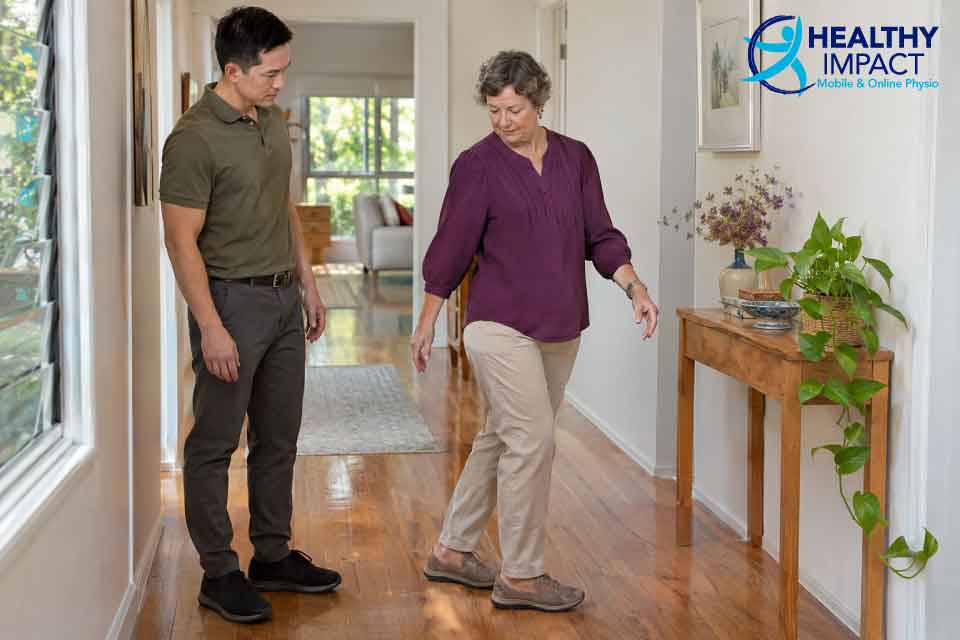
Why Strength Matters for Balance Training
A person requires sufficient strength to perform balance exercises safely and effectively.
The lower limb and trunk muscles control the body’s centre of mass over the base of support. These muscles also produce the steps, reaches, transfers and corrective movements required after a loss of balance.
A person with inadequate muscle strength cannot recover effectively from instability. Common compensation includes gripping furniture, stiffening the body, taking very small steps, widening the feet excessively or avoiding movement.
Muscle power is equally important because many balance corrections must occur rapidly. A person can demonstrate reasonable slow strength but remain unable to produce force quickly enough to prevent a fall.
Strengthening and power training are therefore essential components of falls prevention.
For more on how Scott uses strength exercises to support everyday movement, see Functional Strength Rehabilitation.
How are Balance and Falls Prevention Programs Administered?
Balance training begins at a level determined by the physiotherapy assessment.
Exercises are progressed by changing the base of support and foot position; sitting or hand support; weight distribution, body position and reaching distance; movement direction and speed; head position and visual input; or the supporting surface, obstacle height, task complexity and environmental demands.
Only one variable should change at a time. This allows the physiotherapist and patient to identify whether the exercise remains safe and effective.
An appropriate exercise requires concentration and regular postural adjustments while preserving controlled movement. Continuous gripping support, excessive swaying, breath holding, repeated uncontrolled stepping indicates that the exercise is too difficult.
Effective balance training improves sitting, transfers, wheelchair use, walking, stairs, turning, reaching, household activities, recreation and community mobility. Repeated successful practice also improves confidence, exercise adherence, self-management, independence, emotional wellbeing and quality of life.
A Safety Corner for Falls Prevention Exercises
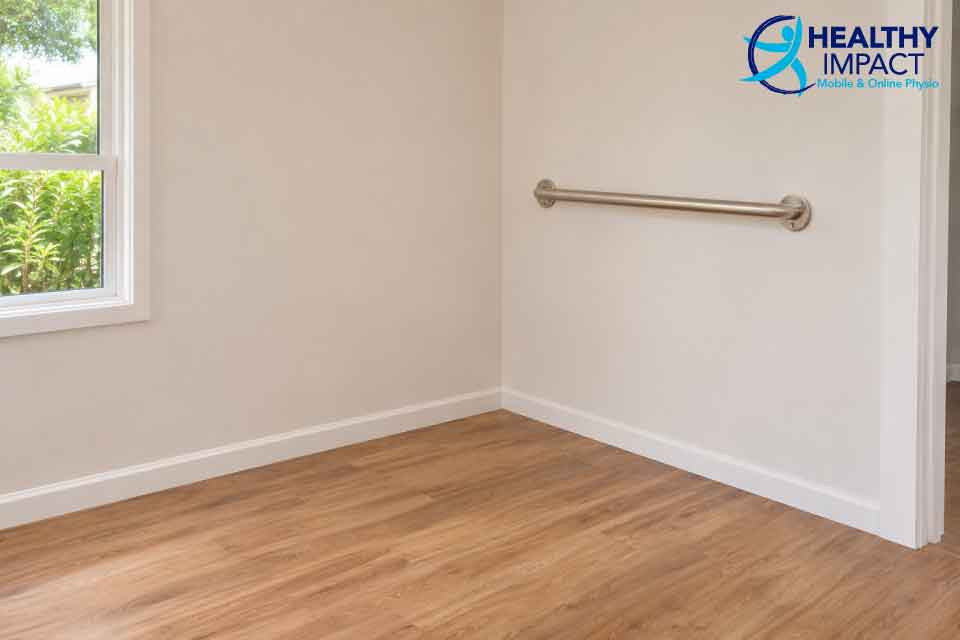
Standing balance exercises must be completed in a safety corner or another physiotherapist-approved setup with close, stable supports.
A suitable safety corner includes:
- Solid walls behind and beside the person.
- A stable bench, rail or fixed support within immediate reach.
- A level, dry, uncluttered and well-lit floor with enough space for safe stepping.
- Appropriate supervision when the person cannot recover independently.
Light fingertip support should be used when necessary. Hand support is reduced only after the person demonstrates adequate strength, postural control and recovery capacity.
Wheeled chairs, lightweight tables, unstable furniture, towel rails, furniture that can slide or tip, walking frames with unlocked brakes, loose objects and door handles that can move unexpectedly are not suitable safety supports.
A safety corner reduces the consequences of losing balance. It does not make an exercise suitable when the exercise exceeds the person’s strength, coordination or reaction capacity.
Footwear for Balance Training
Barefoot practice is the best option for balance exercises when the person has intact skin, adequate sensation, no significant foot pain, no wounds and no medical reason to protect the feet. Barefoot exercise increases direct sensory contact with the floor and allows the toes and intrinsic foot muscles to contribute freely.
Barefoot training is not suitable for every person. People with diabetes-related foot risk, reduced sensation, wounds, significant deformity, prescribed orthoses, foot pain or poor temperature regulation require individual advice.
Balance exercises should never be performed in socks, thongs, loose slippers, Ugg boots or poorly fitted footwear. These options increase slipping and tripping risk, reduce secure foot placement and interfere with controlled movement.
If shoes are recommended, secure and well-fitted shoes are generally the safest choice. Appropriate footwear should provide a secure fastening, a broad stable base, a low heel, adequate grip, a firm heel counter, enough room for the toes and a sole that is not excessively thick or unstable. Well-fitted shoes are essential for functional balance training because people usually walk, turn, negotiate obstacles and access the community while wearing shoes.
How Vision, the Inner Ear and Sensation Support Functional Balance
The nervous system combines information from vision, the vestibular system and proprioception to maintain balance.
Vision
Vision provides information about body position, movement, obstacles and the surrounding environment. Poor lighting, reduced visual acuity, visual distraction and busy environments increase balance demands. Closing the eyes removes an important source of balance information and should only be introduced after adequate control and safety have been established.
Vestibular System
The vestibular system is located in the inner ear. It detects head movement, acceleration and changes in orientation. Vestibular dysfunction can cause dizziness, blurred vision during movement, unsteadiness and difficulty walking while turning the head or navigating visually busy environments.
Proprioception and Sensation
Proprioception provides information about joint position, movement, pressure and muscle activity. The feet, ankles, pelvis, trunk and supporting surfaces provide important information about body position. Reduced sensation, pain, stiffness and unsuitable footwear interfere with this information. Balance training improves how the nervous system receives, combines and responds to sensory information.
How Balance Training and Falls Prevention Exercises Progress
Balance rehabilitation progresses through sitting balance, standing balance, dynamic balance, postural reactions and functional reaching. Progression is based on demonstrated strength, movement control and recovery capacity rather than time alone.
Sitting Balance Training
Sitting balance is essential for people who mobilise in a wheelchair or have limited or no leg strength. Sitting balance requires pelvic stability, trunk strength, postural control, sensation, vision, coordination and the ability to move and recover without falling.
Assessment should examine unsupported sitting, maintaining an upright midline position, reaching forwards and sideways, head turning, lifting one or both arms, completing pressure-relief movements, preparing for transfers, recovering from a balance disturbance and completing wheelchair-based daily activities.
Training can include controlled weight shifts, trunk movements, reaching and returning to centre, transfer preparation and functional wheelchair tasks. The wheelchair must be stable, with brakes applied and anti-tip devices, footplates and close supports used as required. People with severe trunk weakness require close supervision and graded support until they can maintain and recover their sitting position safely. Improved sitting balance supports wheelchair mobility, transfers, dressing, pressure relief, reaching, personal care, meal preparation and participation in daily activities.
Standing Balance Training
Standing balance requires sufficient leg and trunk strength to support body weight and control the body over the feet.
Training begins with a wide and stable stance, close stable support and the amount of hand assistance required for safety.
Standing balance progresses by slowly narrowing the distance between the feet, moving from parallel stance to semi-tandem and tandem stance, progressing to single-leg stance when assessed as appropriate and safe. A person should not progress without being assessed by a physiotherapist.
Standing balance creates the foundation for transfers, walking, turning, stair mobility and safe participation in daily activities.
Dynamic Balance Training
Static standing balance alone does not adequately prepare a person for the changing balance demands of everyday mobility. Dynamic balance is the ability to maintain balance while the body or feet are moving.
Dynamic training includes reaching, weight shifting, stepping, marching, turning, changing direction, walking at different speeds, starting and stopping, walking around or over obstacles, walking on different surfaces, carrying objects and completing functional tasks.
Progression increases movement distance, speed, direction changes and task complexity while maintaining safe foot placement, posture and recovery.
Postural Reactions
Postural reactions are the rapid balance responses used to prevent a fall after a slip, trip, bump or unexpected movement. These responses include ankle and hip strategies, trunk adjustments, reaching for support, protective arm reactions, taking a fast recovery step, repositioning the feet and lowering the body’s centre of mass.
Training uses controlled disturbances, unexpected stepping cues, direction changes and rapid but safe movement responses. Reactive balance exercises require sufficient strength, standing balance, coordination and confidence and should initially be completed under close physiotherapy supervision.
The disturbance level, guarding method and environment must match the person’s strength, mobility, cognition and reaction capacity. Postural reactions should only be assessed by a physiotherapist.
Functional Reach Outside the Base of Support
Functional reaching trains a person to move towards an object, complete a task and return to a stable position without falling.
The base of support is the area beneath the body that provides stability, such as the buttocks and thighs in sitting or the feet in standing. Reaching outside this area requires controlled weight transfer, trunk movement, strength, coordination, accurate judgement of reach distance and an effective recovery response.
Training can include reaching forwards, sideways, across the body, overhead, towards the floor and towards different heights while sitting or standing. Reach distance should increase gradually, and objects should initially remain light and predictable.
Functional reaching improves safety during dressing, personal care, cooking, wheelchair use, transfers, household tasks and retrieving objects without overbalancing.
Walking Base and Foot Placement
A very wide walking base often reflects reduced confidence or lateral instability, while a very narrow or crossing pattern increases the risk of the feet contacting each other and tripping. Inconsistent step width can result from hip weakness, poor trunk control, reduced coordination, sensory loss, vestibular dysfunction or neurological impairment. Treatment develops accurate foot placement, controlled weight transfer and the ability to adapt step width for different spaces, surfaces and tasks. The goal is not one identical walking width for every person, but a stable, efficient and adaptable walking pattern.
Head Turns During Walking
Safe community walking requires the ability to look left and right for traffic, up at signs and down at changes in the ground without stopping or drifting. Excessive slowing, widening or crossing the feet, shortening steps, reaching for support or losing direction during head turns indicates reduced gait adaptability and difficulty combining visual, vestibular and sensory information. Training begins with small, predictable head movements at a controlled speed and progresses to larger movements and more complex environments while maintaining balance, direction and consistent foot placement.
Walking Speed
Walking speed reflects strength, balance, confidence, endurance, pain, fatigue, foot clearance and the ability to process environmental demands. Slow walking is not automatically unsafe when it is used to maintain control, but very slow speed can limit road crossing, community access and the ability to respond to hazards. Assessment should determine whether the person can select an appropriate speed for the environment while maintaining stable steps, direction and posture. Treatment develops safer and more efficient walking without forcing speed beyond the person’s control.
Changing Walking Speed
Everyday walking requires the ability to accelerate, slow down, stop and restart in response to people, obstacles, traffic and changing surfaces. Difficulty changing speed can cause hesitation, shortened steps, widening of the feet, loss of direction or dependence on support. Training begins with predictable verbal or visual cues and progresses towards quicker changes and more realistic environments. The goal is to change speed promptly while maintaining balance, consistent foot placement and controlled stopping.
Starting and Stopping
Safe walking requires controlled movement initiation and deceleration. Difficulty starting can involve hesitation, repeated weight shifts, freezing or very small steps, while difficulty stopping can cause extra uncontrolled steps, forward loss of balance or reaching for support. Training develops forward weight transfer, selection of the first step, stable foot placement, controlled slowing and a secure final position. Starting, stopping and restarting should be practiced because these tasks occur repeatedly during household and community mobility.
Turning Ability
Turning requires controlled weight transfer, trunk rotation, accurate foot placement and rapid adjustment of the base of support. Slow, hesitant or excessive multi-step turns can indicate weakness, reduced balance, fear of falling, restricted movement, vestibular dysfunction or neurological impairment. Training includes turning in both directions, turning around objects, changing direction while walking, turning in confined spaces and turning to sit. The person should slow sufficiently for control while avoiding unnecessary stopping, crossing of the feet or loss of balance.
Obstacle Negotiation
Stepping over an obstacle requires visual detection, depth judgement, movement planning, adequate foot clearance, single-leg support and the ability to continue walking afterwards. Unnecessary stopping, prolonged hesitation or repeated preparation steps can indicate weakness, reduced confidence, poor depth judgement or limited stepping capacity. Training progresses from predictable low obstacles to varied objects and environments. The aim is to approach, adjust speed, clear the obstacle and continue moving with control rather than stopping unnecessarily or rushing.
Walking and Functional Balance
Walking requires continuous balance while speed, direction, surfaces and environmental demands change. Functional training combines starting, stopping, speed changes, head turns, obstacles, narrow spaces, uneven ground, stairs, kerbs, carrying objects and interacting with doors or other people. Dual-task activities such as walking while talking, carrying an item or following instructions are added only after the person maintains safe walking quality. Increasing complexity too early reinforces poor movement and increases falls risk.
Confidence, Independence and Participation
Fear of falling often causes people to reduce walking, transfers, wheelchair activities, exercise, recreation and community participation. Reduced activity then causes further weakness, poorer balance, reduced fitness and greater dependence. This creates a cycle of declining physical capacity and increasing falls risk.
A well-designed program provides achievable challenges and repeated successful movement experiences. This develops genuine confidence based on improved ability. Better balance supports personal care, transfers, wheelchair mobility, household activities, shopping, travel, family activities, work, recreation, social participation and community access. Maintaining mobility also supports emotional wellbeing, wellness, dignity and independence.
Falls Prevention Beyond Exercise
Falls usually result from several interacting factors.
A comprehensive program also considers:
- Home and community hazards, lighting, floor surfaces, stairs and access requirements.
- Walking aids, wheelchairs, transfer equipment, foot pain and footwear.
- Vision, hearing, dizziness, vestibular function and postural blood pressure changes.
- Medication effects, continence, cognition, attention, fatigue and sleep.
- Nutrition, hydration, bone health and other medical factors that affect falls risk.
- Fear of falling, unsafe risk-taking and excessive restriction of activity.
Physiotherapists address factors within their scope and communicate with GPs, pharmacists, optometrists, podiatrists, occupational therapists and other health professionals when required.
A walking aid improves safety only when it is correctly prescribed, adjusted, maintained and used.
For more information on fall risks and prevention, see Healthdirect’s guide to older people and falls.
How Often Are Balance Training and Falls Prevention Exercises Practised?
Balance and coordination activities should be completed on two to three days each week.
Short, regular sessions are more effective than occasional large sessions. Practice must create enough challenge to produce adaptation without causing unsafe fatigue or loss of control.
Patients at higher falls risk require supervised practice until they demonstrate safe setup, correct technique, appropriate exercise selection, reliable use of stable support, controlled recovery strategies and understanding of when to stop. Balance improvements require ongoing practice. Stopping the program allows strength, coordination and confidence to decline.
Reviewing Progress in Balance and Falls Prevention Programs
Balance programs require regular assessment and progression. The physiotherapist reviews sitting balance, functional reaching, trunk control, strength, sit-to-stand ability, static standing balance, dynamic balance, reactive balance, walking speed and speed changes, step width and foot placement, head turns, obstacle negotiation, turning, stairs, wheelchair mobility, transfers, falls, near falls, confidence and functional goals.
Exercises progress when the person demonstrates consistent control and safe recovery. Exercises are modified when pain, fatigue, dizziness, fear, poor technique or excessive reliance on support develops. Progress feedback helps the person recognise meaningful improvements. This strengthens motivation, exercise adherence, self-management and confidence.
Safety Considerations
Balance exercises must always be matched to the person’s assessed capacity and completed in an appropriate safety setup.
The person should not practise beyond their ability to recover safely.
Advanced dynamic, dual-task and reactive exercises require direct supervision until the physiotherapist confirms they are appropriate for independent practice.
Exercise should stop and appropriate medical assistance should be sought when the person develops near-fainting or loss of consciousness, new or severe dizziness, chest pain or significant shortness of breath, sudden weakness or new neurological symptoms, or repeated uncontrolled loss of balance.
Pain increases should remain below 3/10 and return to baseline within approximately 24 hours.
Fatigue must not reduce safety during the session or during essential activities afterwards.
The goal is to challenge balance safely, not to repeatedly lose control or fall.
Balance and Falls Prevention Programs can include exercises for sitting, standing, walking and reaching. For an overview of the other approaches Scott uses on the Sunshine Coast, explore Healthy Impact’s physiotherapy treatments.
Frequently Asked Questions About Balance and Falls Prevention Programs
What does a balance assessment look at?
A balance assessment looks at your history of falls or near falls and how you manage tasks such as sitting, standing, reaching, walking and turning. A physiotherapist may also consider your strength, sensation, vision, footwear and hazards in your home.
How does balance training progress from sitting to standing?
Balance training starts at a level that matches your assessed ability. It may begin with seated weight shifts or reaching, or with supported standing. Your physiotherapist adjusts the difficulty as you demonstrate control and the ability to recover safely if you lose balance.
How do falls prevention exercises relate to everyday walking?
Falls prevention exercises can include practising turns, changes in walking speed, stepping over obstacles and looking around while walking. Your physiotherapist chooses tasks that reflect the situations you encounter at home and in the community.
What is functional balance?
Functional balance is the ability to stay steady during everyday activities such as getting out of a chair, reaching for an object or turning while walking. It also involves adjusting your position when a task or your surroundings change.
When are Balance and Falls Prevention Programs reviewed?
Balance and Falls Prevention Programs are reviewed regularly. Your physiotherapist checks your movement, confidence and ability to recover from a loss of balance, then adjusts the exercises in response to your progress and any difficulties you report.
What else do Balance and Falls Prevention Programs consider beyond exercise?
Balance and Falls Prevention Programs can also consider home hazards, lighting, footwear, walking aids, vision, dizziness and medication effects. Your physiotherapist can address factors within their scope and work with your GP or other health professionals where needed.
For more information about appointments, referrals and rebates, read our FAQs. You can also view appointment times and consultation fees.
Disclaimer
This content is intended for general information only and should not be taken as medical advice. Always consult a qualified health professional for assessment and treatment.
References
Research Evidence
Devasahayam, A. J., Farwell, K., Lim, B., Morton, A., Fleming, N., Jagroop, D., Salbach, N. M., & Mansfield, A. (2023). The effect of reactive balance training on falls in daily life: An updated systematic review and meta-analysis. Physical Therapy, 103(1), pzac154. https://doi.org/10.1093/ptj/pzac154
Hopewell, S., Adedire, O., Copsey, B. J., Boniface, G. J., Sherrington, C., Clemson, L., Close, J. C. T., & Lamb, S. E. (2020). Multifactorial and multiple component interventions for preventing falls in older people living in the community: A systematic review and meta-analysis of 41 trials and almost 20,000 participants. British Journal of Sports Medicine, 54(22), 1340-1350. https://doi.org/10.1136/bjsports-2019-100732
Sherrington, C., Fairhall, N. J., Wallbank, G. K., Tiedemann, A., Michaleff, Z. A., Howard, K., Clemson, L., Hopewell, S., & Lamb, S. E. (2020). Exercise for preventing falls in older people living in the community: An abridged Cochrane systematic review. British Journal of Sports Medicine, 54(15), 885-891. https://doi.org/10.1136/bjsports-2019-101512
Sturnieks, D. L., St George, R., & Lord, S. R. (2008). Balance disorders in the elderly. Neurophysiologie Clinique/Clinical Neurophysiology, 38(6), 467-478. https://doi.org/10.1016/j.neucli.2008.09.001
Best Practice Guidelines
Australian Commission on Safety and Quality in Health Care. (2025). Preventing falls and harm from falls in older people: Best practice guidelines. Sydney, Australia: Author. Retrieved from https://www.safetyandquality.gov.au/clinical-topics/falls
Australian Government Department of Health, Disability and Ageing. (2026). Recommendations for older adults aged 65 years and over. Canberra, Australia: Author. Retrieved from https://www.health.gov.au/topics/physical-activity-and-exercise/physical-activity-and-exercise-guidelines-for-all-australians/for-older-australians-65-years-and-over
Montero-Odasso, M., van der Velde, N., Martin, F. C., Petrovic, M., Tan, M. P., Ryg, J., Aguilar-Navarro, S., Alexander, N. B., Becker, C., Blain, H., Bourke, R., Cameron, I. D., Camicioli, R., Clemson, L., Close, J., Delbaere, K., Duan, L., Duque, G., Dyer, S. M., … Masud, T. (2022). World guidelines for falls prevention and management for older adults: A global initiative. Age and Ageing, 51(9), afac205. https://doi.org/10.1093/ageing/afac205
External Resources
Australian Commission on Safety and Quality in Health Care. (n.d.). Falls. Retrieved from https://www.safetyandquality.gov.au/clinical-topics/falls
Healthdirect Australia. (n.d.). Older people and falls. Retrieved from https://www.healthdirect.gov.au/falls